
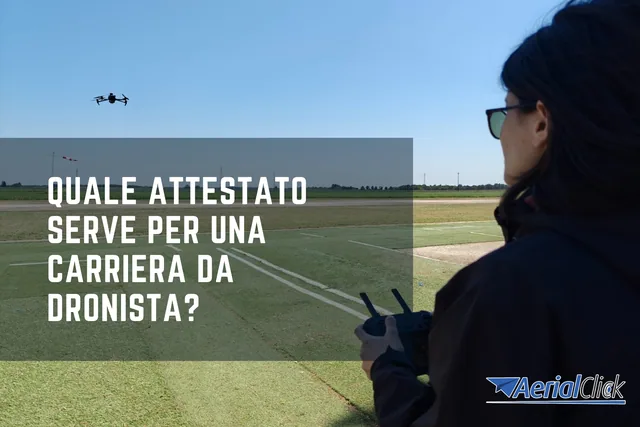
Flying a drone: which certificate do you need?
When it comes to flying drones for civil and professional purposes, the European regulations currently in force provide for a classification based on the level of...
· 4 min read
Archive article. Article from 2015: since 31 December 2020 European rules (Regulation EU 2019/947) apply in Italy, and the information on SAPR (UAS), certifications and certificates described here is no longer in force. Read which certificates are required today
As everyone now knows, also according to economic analysts at Il Sole 24 Ore and illustrious marketing, work and economics magazines, SAPR (UAS) Operators are increasingly sought-after professionals because they can carry out dangerous and complex jobs and perform operations in various fields that once required time, physical effort and a considerable amount of risk to property and above all to people (risk to the workforce).
The feminine form 'Operatrici SAPR' (female UAS operators) is more than appropriate since the trend began as purely male but the female presence is growing enormously, at a pace decidedly higher than in other jobs involving technological skills. Dronics is a new and growing field and for this reason too it is one of those work sectors where the so-called and much-hated 'glass ceiling' that blocks women's entry, along with lower pay levels, does not appear.
The use of drones is useful and will soon be indispensable in a great many sectors, ranging from smart agriculture to the protection of environmental heritage, from security to construction, from promotion to cinema. But does that mean all agronomists, film crew members, camera operators, architects and engineers should get a licence to pilot drones and buy a hexacopter with all the necessary accessory equipment and specific software?
Well, it would certainly be a stroke of luck for the companies and bodies that can issue the ENAC certification, but the truth is no, it is not necessary to become a drone pilot to carry out at best all the activities in which drones are indispensable. In many cases it is possible to have one or more services performed with a drone while following other routes.
Let's look at concrete examples, easily extended from sector to sector:
you are an agronomist and you want to carry out surveys with aerial spectral imaging that show which areas of your land need more water, fertiliser, light?
Do you want to carry out a prolonged analysis of the health of your crops and repeat the experiment periodically to keep everything under control in a natural and intelligent way? In that case a course to become a drone pilot could even be detrimental: it would involve an outlay of money and above all of time that you would have to take away from your core business.
In this case it is better to collaborate with professionals already recognised by ENAC, with experience in the mapping sector behind them and (quite expensive) software already purchased, which would allow your business to receive every year useful data that can be cross-checked against data collected in future periods.
A similar argument applies to architects and engineers with their own practice who do not have a very flourishing staff behind them: learning and perfecting piloting technique and studying the regulations could take precious time away from managing their clients and looking for new ones, whereas only large companies, which have staff to train for non-core activities that can bring benefits in the medium to long term, can afford this.
In these cases it is better to rely on professionals whose only job is being drone pilots, and who can therefore devote the time of an entire project to your goal and follow you even for medium to long periods (as in agricultural mapping, where data cross-checked from year to year is extremely important).
It is different for other categories for which aerial filming (or filming in general) is the core of their activity or one of its key aspects.
For example, for surveyors, often engaged in surveys and mapping for construction and urban planning, the time and money invested in a SAPR licence is soon recouped by the savings in time and costs (including human resources) of performing the same services with a drone. The time needed for an appraisal of a building plot, for example, can drop from four or five days to half a day.
The same applies to those working in documentary or film production: directing requires a complete and complex vision of the editing and the storyboard, so for a better final result it is advisable for the aerial shots to be taken by whoever shoots or oversees the ground shots.
If this holds for those working with large crews (film sets, audio-video production companies, etc.), it holds even more for independent filmmakers who use the web to distribute their work; in short, the director of the future must also be a SAPR operator.
Starting from the premise that you must make sure the course provider is a company recognised by ENAC and included in the relevant list of bodies authorised to issue qualifications, one selection criterion can be geographical, that is, choosing the certifying body that is geographically closest.
This is the most "convenient" criterion, although the weakest on the technical side, since many companies hold courses in several parts of Italy (like Aerialclick) and soon it will also be possible to follow parts of courses online.
A better criterion is to choose a certifying body that is also engaged in the design and maintenance (and even construction) of drones, and that is therefore able to support you not only in the training and certification phases but can remain a true point of reference throughout your whole career, also helping with its 'critical' moments such as breakage or damage to your work tool, advice on regulations, etc.
Aerialclick is among the latter; if you like, take a look at our offer.
We prepare you for the ENAC exam for the A1/A3, A2 and STS certificates with instructors who fly every day: classroom courses in Brindisi, Calatabiano and Potenza, plus online lessons.
Discover the ENAC courses
When it comes to flying drones for civil and professional purposes, the European regulations currently in force provide for a classification based on the level of...
· 4 min read
Drones are taking up more and more space in our lives, both as work tools and as fascinating hobbies. But before you take off with your...
· 4 min read
The Italian Civil Aviation Authority (ENAC) has recently released a circular providing crucial clarifications on the maximum take-off mass (MTOM) for...
· 2 min read
🍪 Cookies on AerialClick
We use technical cookies, which are necessary for the site (cart, login). With your consent we also use marketing cookies (Meta) to measure campaigns and show you relevant ads. You can change your mind at any time from "Cookie preferences" at the bottom of the page. Cookie policy