
Flying a drone: which certificate do you need?
When it comes to flying drones for civil and professional purposes, the European regulations currently in force provide for a classification based on the level of...
· 4 min read
Archive article. Article from February 2021: the transitional period described here ended on 1 January 2024 and some rules have changed. Read which certificates are required today
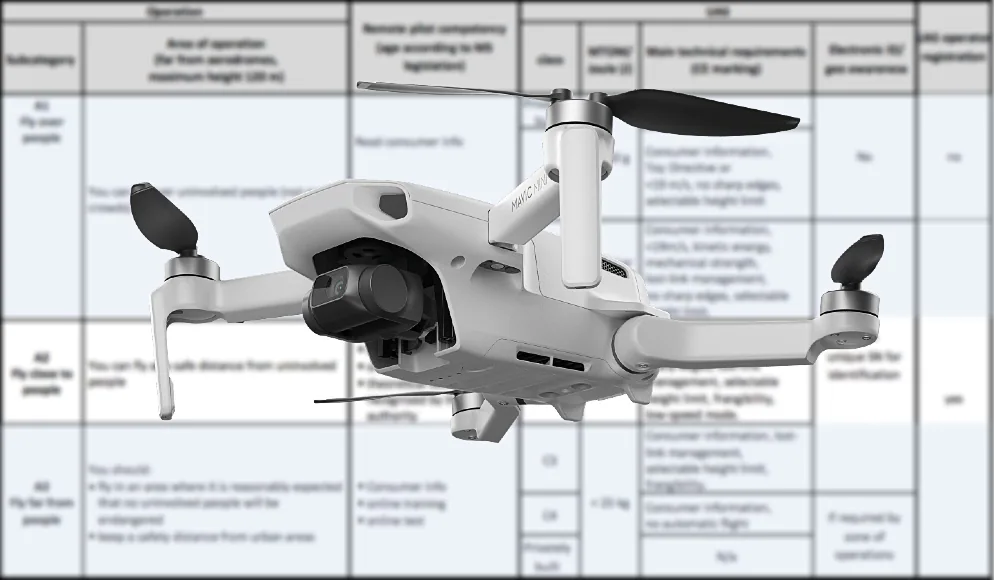
The rules governing the use of drones are changing, and ENAC announced the news several days ago.
Italian regulations are replaced by European ones (EASA), so from 1 January 2021 all operators concerned must comply with the new rules imposed by European law and make any necessary changes in order to operate in full compliance with the law.
Here is what changes and what stays the same, at least for now:
Until 1 January 2023, current drones that do not have a class marking can be used in the "Limited Open Category" – a category in which national authorities may require additional requirements from the pilot. However, according to the UAS-IT regulation, ENAC has decided to align with European rules, without asking for any further requirements from pilots of drones without a marking. Specifically, according to the ENAC regulation, this category includes small-sized aircraft that can be flown by anyone, drones generally used for fun and leisure.
The requirements to be met in order to fall into this category are the following:
If these conditions are not met (even just one of them), the EASA regulation establishes that you fall into the “Specific” category, in which case the requirements change for each class.
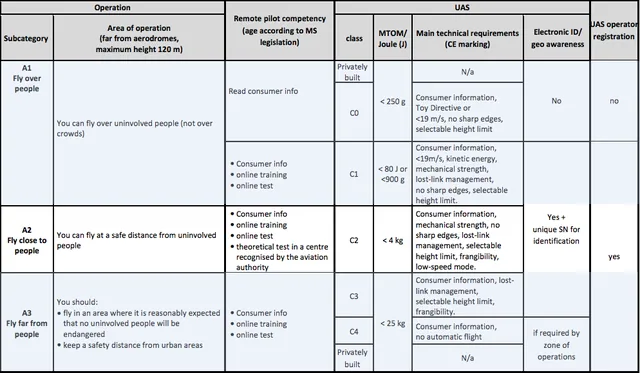
There are in fact subcategories of the “Open” category, which differ based on the drone's flight position relative to people:
To fall within subcategory A1 you can only fly drones weighing less than 250 g such as the DJI Mini 2 or drones weighing between 250 and 900 g that carry the CE marking. This class also covers flights over urban areas.
The first requirement for flying in subcategories A1-A3 is to attend an online course (strongly recommended), which must then be followed by an online exam (required to obtain the pilot certificate). Those who fly drones with a take-off weight under 250 g, whether self-built or commercial, are exempt from this requirement.
The subcategory A3 includes all drones that do not fall into the other classes: self-built drones weighing more than 250 g, drones with a take-off weight of more than 900 grams (if you do not hold an A2 certificate), and you must fly at a distance of 150 metres from buildings and uninvolved people.
If a drone weighs more than 900 grams and carries the new CE mark, it can also fly close to people, but only if the pilot has taken and passed a theory test and holds the license A1-A3 and has subsequently obtained the A2 certificate in proctored mode.
The new CE mark is the new label (class) followed by a number indicating the subcategory the drone falls into. For example: CE-01, CE-02, CE-03.
We prepare you for the ENAC exam for the A1/A3, A2 and STS certificates with instructors who fly every day: classroom courses in Brindisi, Calatabiano and Potenza, plus online lessons.
Discover the ENAC courses
When it comes to flying drones for civil and professional purposes, the European regulations currently in force provide for a classification based on the level of...
· 4 min read
Drones are taking up more and more space in our lives, both as work tools and as fascinating hobbies. But before you take off with your...
· 4 min read
The Italian Civil Aviation Authority (ENAC) has recently released a circular providing crucial clarifications on the maximum take-off mass (MTOM) for...
· 2 min read
🍪 Cookies on AerialClick
We use technical cookies, which are necessary for the site (cart, login). With your consent we also use marketing cookies (Meta) to measure campaigns and show you relevant ads. You can change your mind at any time from "Cookie preferences" at the bottom of the page. Cookie policy