
DJI Neo vs DJI Neo 2: what has changed? The complete comparison
The Neo series was created to offer a simple, intuitive flying experience for those who want to start recording quality content without complications,...
· 3 min read
Archive article. Article from 2018: some of the models mentioned are no longer in production. Today the equivalent model is DJI Neo 2. Discover DJI Neo 2
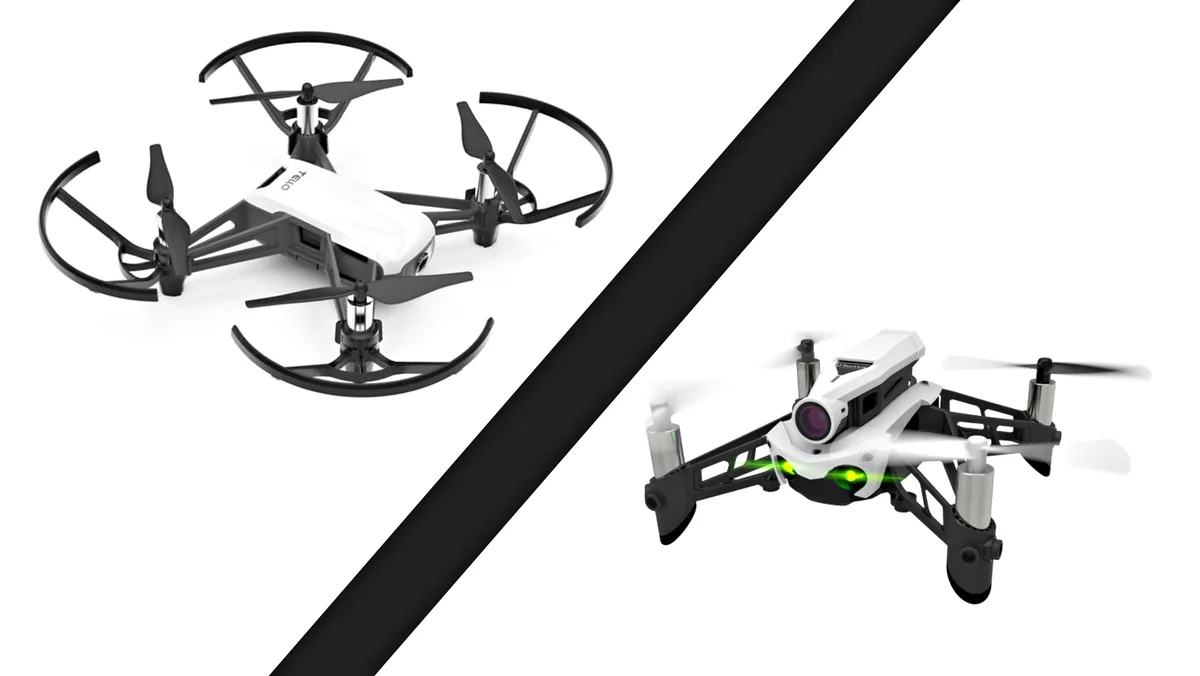
The two leading drone manufacturers, DJI and Parrot, have created two aircraft for beginners, useful not only for training but above all for flying indoors.
Now let's introduce the drones: the one from Parrot is the Parrot Mambo FPV, while the one from DJI, in collaboration with Ryze Tech, is the DJI Ryze Tello .
DESIGN
The Mambo's design immediately looks more eye-catching than the DJI drone.
It has two front leds , unlike the small front LED of the DJI Tello. The LEDs are not just aesthetic, but are needed to check the status of the aircraft, both in flight and on the ground. Moreover, the design of the Parrot's arms is very appealing, far more complex than those of DJI. The Tello, in fact, having sturdier arms but also a built-in camera, is certainly a more compact drone, but less "sophisticated in its lines" compared to the Parrot Mambo, which can mount its camera with a Lego-style attachment directly on top of its body.
That said, the Tello's robust structure with more resistant propellers and propeller guards proves more effective than the Mambo not only in case of impacts, but above all for flying more stably even outdoors in windy conditions.
The Tello, therefore, seems to sacrifice some of the refined look and complexity of the Mambo in order to make flights safer.
FEATURES
As similar as they are, it is immediately clear that, while the Parrot Mambo and the DJI Ryze Tello have in common that they are both considered quadcopters suited to beginners or ideal for anyone approaching the world of drones for the first time, they seem to have been designed for different uses; if the Tello supports the needs of those who want to start taking aerial photos or shooting footage from above, the Parrot drone, instead, positions itself as a racing drone.
This fundamental difference makes the drones equally different in both features and piloting, a difference you need to rely on to choose which category to try your hand at, namely that of the photographer or that of the racer.
To make full use of the features of both drones, they must be connected to the following apps:
- TELLO for the DJI Ryze Tello, essential even just to fly the quadcopter;
- FREEFLIGHT MINI for the Parrot Mambo, not strictly necessary to fly the drone, but certainly essential if you want all the features Parrot has to offer.
Both applications are very similar to each other: they require a Wi-Fi connection between the mobile device and the drone and, once connected, you will notice that the app's main interface is nothing other than the drone's camera itself.
As mentioned earlier, since the drones were designed for different uses, the features the apps offer are also different. The Mambo, which is certainly faster and more maneuverable than the Tello, has three different flight modes (normal, racing and drift), unlike the Tello, which has only two (normal and fast) that in any case do not change its three-axis stabilization.
On the other hand, the DJI drone focuses more on photo and video quality, which is why the "Tello" app offers not only the option to choose a normal or high photo and video resolution (unlike the Mambo, which offers no way to get higher quality except by using an SD card), but also lets you use the panoramic shot performed automatically with the 360° function, while the circle function allows the Tello to record footage while automatically flying in a circular movement, as the name itself says.
For the rest, both applications offer more or less the same features, such as the ability to perform stunts, the FPV flight mode and the Throw & Go function, that is, the function that lets the drone take off from your hand.
However, there are some weak points on both sides that are worth mentioning.
- Parrot Mambo FPV
As for the Parrot drone, the poor connection stability means that video recorded directly on the mobile device is disturbed by interference. For this reason, a great idea that definitively solves this problem was to give the Mambo the ability to record directly to MicroSD, offering higher quality in the final footage (up to 720p). On the other hand, if a connection stability problem occurs, you don't need to worry about your aircraft. In fact, if the drone disconnects from the controller, the Failsafe system will activate automatically and land the quadcopter safely (a function the Tello also has). In fact, no FlyAway situations, with the resulting risk of losing the drone, have ever been reported in such cases.
A very well-known problem among Mambo owners is the presence of the propellers in the video footage. Unfortunately, the wide-angle lens lets the propellers appear at the sides of any video, even though numerous updates have been released that have reduced the annoyance of propellers showing in the camera view.
- DJI Ryze Tello
As for the DJI drone, the problem is actually not with the drone, but with the device it is connected to. In fact, it is very common for the device used to fly the Tello to fail to capture all the video frames the drone transfers from its camera. This compromises the smoothness of the video and the footage will suffer some frame drops, which, in plain terms, means the video "stutters". The problem is not easy to solve, since the Tello unfortunately offers no MicroSD support (unlike the Mambo), which would almost certainly solve the problem.
It should be added that no problems of this kind have ever been reported with iOS devices, unlike many Android devices (except the most recent models).
Of course, if the device is powerful enough, Android systems can also capture great footage. So, if you run into this kind of problem, it will almost certainly be solved simply by replacing the device used to fly the drone.
WEIGHT
MAMBO - 63g without accessories and propeller guards / 73g with camera
TELLO – 80g
FLIGHT TIME
MAMBO - 8 minutes with accessories or propeller guards
TELLO – 10 minutes of flight time with propeller guards
CHARGING TIME
MAMBO – 30 minutes
TELLO – 1 hour 30 minutes
GPS SYSTEM
MAMBO – No, VPS system only
TELLO – No, VPS system only
MAXIMUM CONTROL DISTANCE
MAMBO – 100 meters
TELLO – 100 meters
VIDEO QUALITY
MAMBO – HD 720p at 30 FPS
TELLO – HD 720p at 30 FPS
COMPATIBILITY
MAMBO - iOS 7 and above / Android 4.3 and above
TELLO – iOS 9 and above / Android 4.4.0 and above
MICRO SD SUPPORT
MAMBO – Yes
TELLO – No
USB CONNECTION
MAMBO – Yes
TELLO – Only for charging the battery
PRICE
The Parrot Mambo costs € 179,90 at list price, in a package that includes:
- 1 Drone
- 1 FPV Camera
- 1 FlyPad
- 1 Battery
- 4 Propeller guards
- 1 Parrot Cockpitglasses 2
- 1 USB cable
- 1 Manual + StickersThe price of the DJI Ryze Tello is only € 109,00 in a package that includes:
- 1 Drone with built-in camera
- 1 Battery
- 4 Propeller guards
- 4 Spare propellers
- Manual
If you want to get as close as possible to the Parrot Mambo FPV package by adding the FlyPad, you need to buy:
- GameSir T1d Controller - € 34,00
It is possible to pilot the DJI Tello from FlyPad by connecting the latter with bluetooth to the Tello application , but even if the radio control makes flying more comfortable and safe, it is not essential.
Then? Which quadcopter will you choose to start flying with?
Selected by our staff based on the topic of the article. Not sure which one to choose? Ask us for advice.
We are an authorised DJI reseller and carry the main professional brands: we will advise you with no obligation, also on WhatsApp.
Go to the shop
The Neo series was created to offer a simple, intuitive flying experience for those who want to start recording quality content without complications,...
· 3 min read
DJI has introduced, just a few months apart, two drones designed specifically to meet the needs of beginner pilots: the DJI Neo and the DJI Flip .
· 4 min read
With the evolution of FPV (First-Person View) technology, DJI has recently launched two models that have captured the attention of drone enthusiasts: the...
· 4 min read
🍪 Cookies on AerialClick
We use technical cookies, which are necessary for the site (cart, login). With your consent we also use marketing cookies (Meta) to measure campaigns and show you relevant ads. You can change your mind at any time from "Cookie preferences" at the bottom of the page. Cookie policy