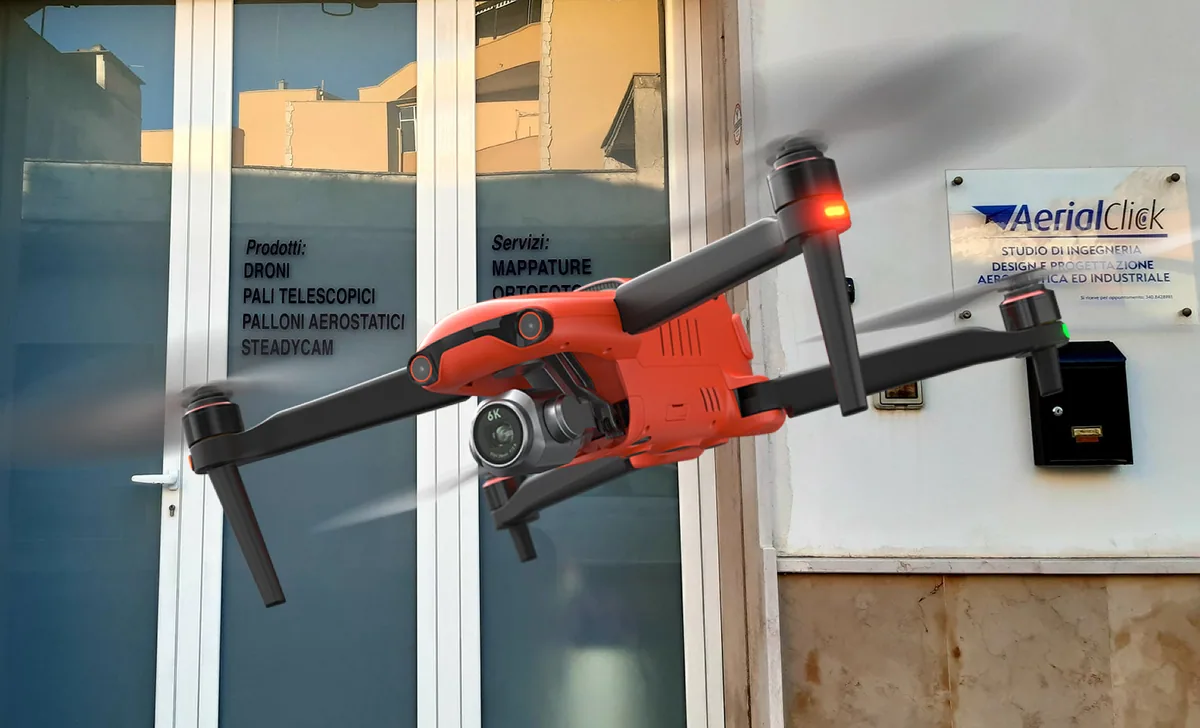
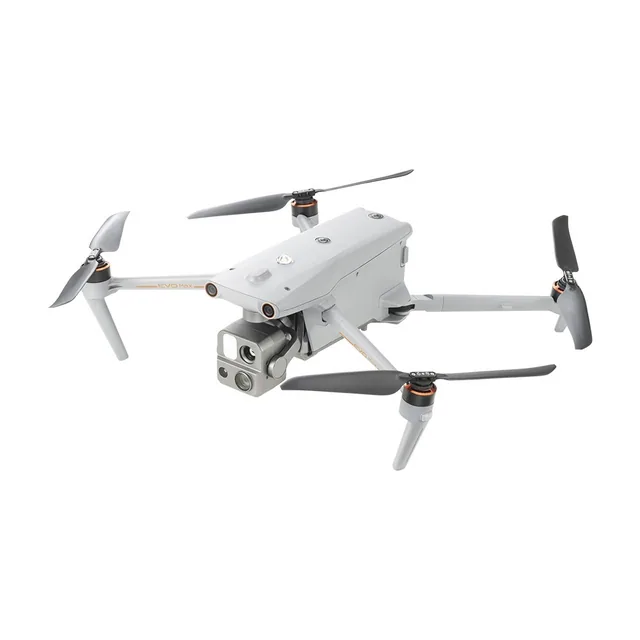
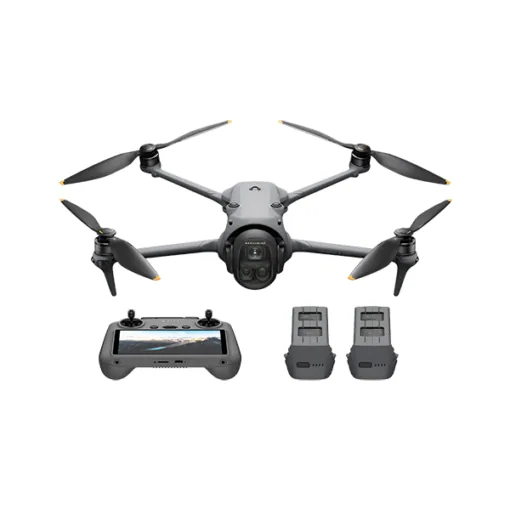
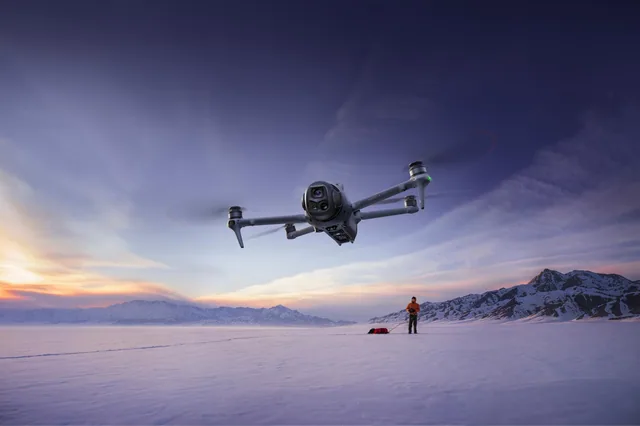
Autel Robotics announced the EVO II series drone at CES 2020, promising major improvements over the original EVO model launched in 2018. Its most notable feature is a modular camera system, offering three models that cover a range of capabilities to meet the different needs of users, from consumers to professionals.
- The camera of the standard EVO II uses a 48 MP 1/2" Quad Bayer sensor and is the first consumer drone to offer 8K video.
- The EVO II Pro uses a larger 20 MP 1" sensor that offers 6K recording.
- The EVO II Dual features both an optical and a thermal camera in a single unit and also tops out at 6K recording. The modular system allows users to swap cameras as needed on a single drone.
KEY SPECIFICATIONS (EXCLUDING CAMERA):
- 3-axis gimbal
- Support for H.264 and H.265 codecs at 120 Mbps
- HDR video with resolution up to 4K
- 10-bit A-Log gamma
- 40-minute battery life (35 minutes hovering)
- 12 computer vision sensors for omnidirectional obstacle avoidance
- Controller with built-in colour screen
- 9 km video transmission
- No geofencing
- No online access required to fly
The lack of geofencing will certainly appeal to some, and the 40-minute flight time is impressive. However, there are key differences between the models depending on the camera you intend to use.
Drone and controller
The EVO II features 12 vision sensors located on the front, rear, top, bottom, left and right sides of the aircraft for omnidirectional obstacle avoidance. There are also two ultrasonic sensors on the underside of the drone for precise hovering.
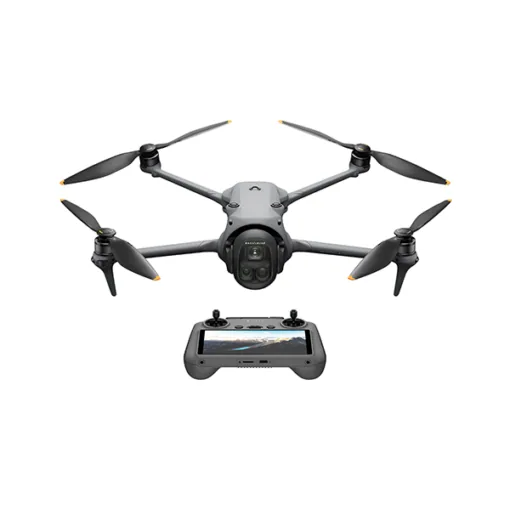
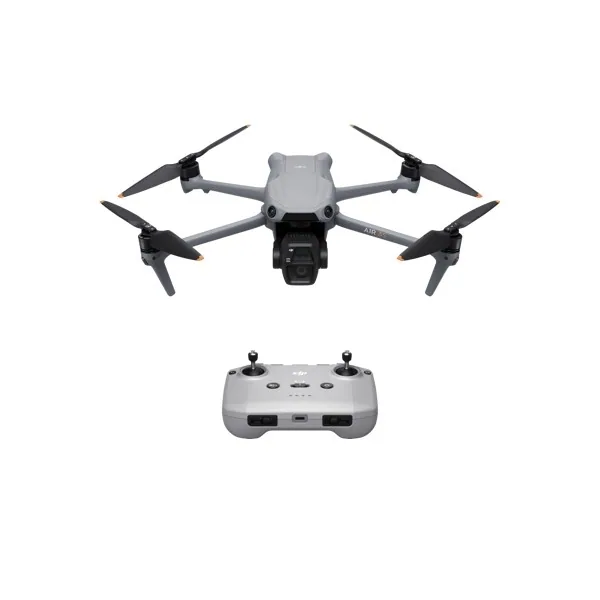
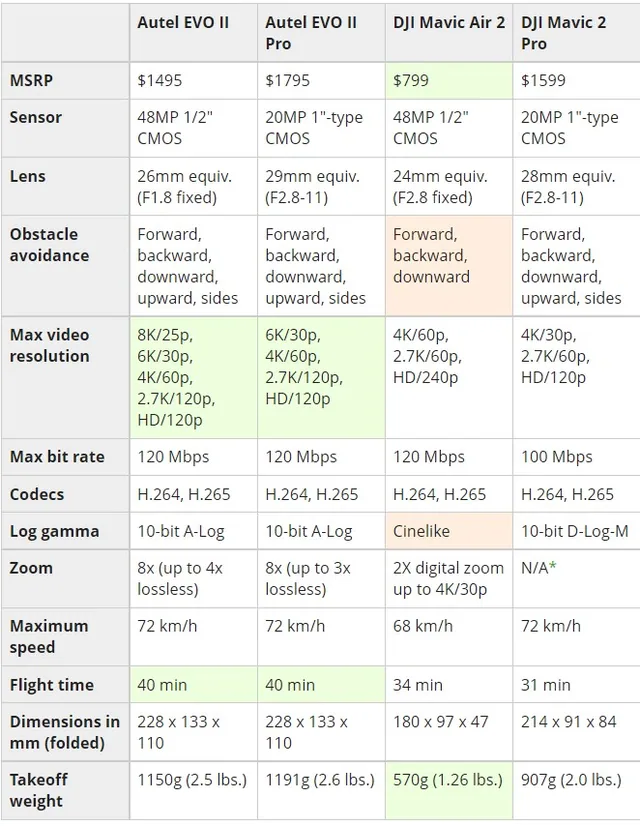
Autel claims a battery life of 40 minutes in flight and 35 minutes in flight with no wind. By comparison, the Mavic Air 2 reaches 34 minutes while the Mavic 2 Pro reaches about 30 minutes. Those extra 6-10 minutes of battery life matter if you are carrying out an inspection or mapping a site.
The battery is huge (7,100 mAh) and slides easily in and out. According to Autel, a "patented Battlock system" prevents the battery from being ejected during fast flights or crashes.
You can access the media files stored on the drone through a USB-C port on the right side. On the opposite side there is a microSD slot that accepts a card of up to 256 GB.
REMOTE CONTROLLER
The EVO II is powered by the same type of remote controller as the original EVO, with two ergonomic grips that fold out from the bottom and are made of smooth plastic.
The mobile device clips onto the controller and you do not need to remove the case from your smartphone. Just like the original EVO or competing Mavic models, tablets will not fit. The main body of the controller has a built-in 3.3-inch OLED display.
Unlike recent Mavic controllers, there is no simple routing solution for connecting your mobile device if you are using an Apple iPhone. Instead, you will find a USB Type-A port on the bottom of the controller. This means you need to supply your own connection cable, just like the 2016 DJI Phantom 4 models. A USB Type-C connector is included for all other smartphones.
You can program the optional buttons to perform different functions, but you will probably trigger a function unintentionally at least once per flight.
CAMERAS
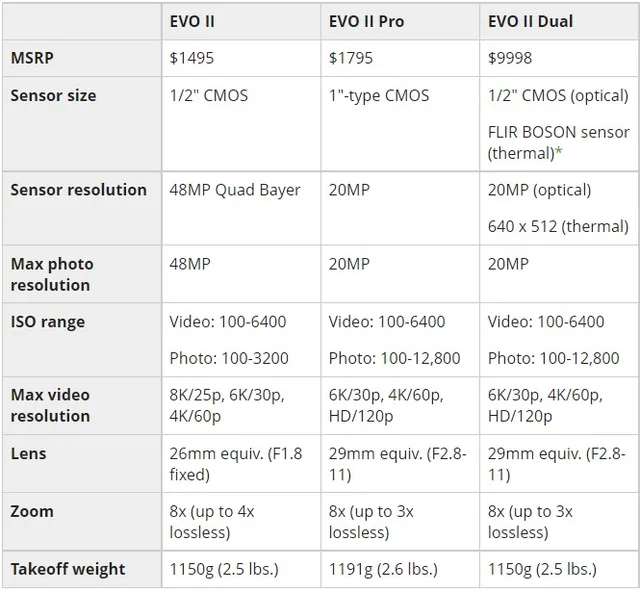
The standard EVO II includes a camera with a 1/2" Quad Bayer CMOS sensor, tilting from straight ahead to 30º above the horizon, and can capture Raw or JPEG images at resolutions of up to 48 MP. It uses a 26 mm (equiv.) fixed-aperture F1.8 lens with a 79º FOV and offers 8x digital zoom, with a maximum advertised lossless zoom of 4x.
With the EVO II you can select Burst mode or shoot up to 5 consecutive photos in Auto Exposure Bracketing (AEB) mode. This gives you the unique ability to create 48 MP High Dynamic Range (HDR) images instead of being limited to 12 MP images. One drawback: you can only shoot in AEB and Burst while in Auto mode.
The EVO II Pro features a camera with a 1" 20 MP CMOS sensor and a slightly narrower 29 mm (equiv.) lens. However, it has an adjustable aperture ranging from F2.8 to F11. Like the camera on the standard EVO II, it offers 8x digital zoom, with a claimed 3x lossless zoom.
Unlike the standard EVO II, the EVO II Pro captures 10-bit 6K video. Although it has a lower resolution than the 8K video on the standard model, the larger sensor delivers footage closer to the world of cinematography. Recording options include 6K/30p, 4K/60p and FHD/120p at 120 Mbps. As with the standard camera, you can zoom in while recording video.
While 8K and 6K video can offer more detail, heavy compression compromises quality. As we explained in another article, many computers are still not equipped to handle 8K footage. 4K/60p on the EVO II is crisp and sharp, even more so than on the Mavic 2 Pro, and is probably sufficient, especially for those who frequently record video clips.
Autel offers the option to record in A-Log, which delivers flat, neutral footage with dynamic range and color grading flexibility. It gives customers eight free Look Up Tables (LUTs) compatible with the most popular video editing programs such as Adobe Premiere Pro and Final Cut Pro
Autel Explorer app
The photo and video settings are found at the bottom of the "Camera" section from the main screen. You can select file sizes, shooting modes and file type (Raw, JPEG, MP4 and MOV).
Information such as remaining battery time and the drone's latitude and longitude position is at the top. Autel Explorer uses Google Maps, a nice addition given the extra detail it provides about the surrounding environment.
Flight modes
The EVO II offers eight intelligent flight modes. Like most consumer drones in its category, it can track subjects such as cars, animals and boats using Dynamic Track. There is also Tripod Track mode, Parallel Track mode and Viewpoint mode.
Orbit mode lets you fly clockwise or counterclockwise around a designated subject. Unlike DJI drones, you can change the drone's altitude while it is in autonomous flight.
Notably missing is the ability to record a "dronie" or "rocket" clip, two of the most popular automated features in which the drone flies away from you or straight up. While these two functions appeal more to casual users, the inability to capture a panoramic shot is particularly unfortunate for professionals.
No geofencing
One thing many users will appreciate is the lack of geofencing, a feature found on DJI drones that prevents them from flying in restricted areas.
Although considered a safety feature, it can be a serious inconvenience for a pilot who has obtained permission to fly, for example, in busy commercial airspace, only to find that the drone will not take off because of a technical issue. Authorizations occasionally do not work properly on DJI drones, preventing the drone from taking off. There is no such problem with the EVO II.
MODEL COMPARISON
FLYING EXPERIENCE
Some say the Autel EVO II "looks like a bus". It boasts a sturdy build and the bright orange color makes it easy to spot. Autel made the airframe larger to house a bigger battery that powers the drone for up to 40 minutes.
When it comes to taking off and maneuvering, and even trying to fly in a straight line, the EVO II is not as agile as the Mavic Air 2, which is nimble and skilled at maneuvering in tight spaces, or the Mavic 2 Pro.
Once in flight, it has excellent handling.
The learning curve for making use of all the additional features in the EVO II is very quick. Smart Orbit, which was recently introduced, lets users draw a box around the main subject.
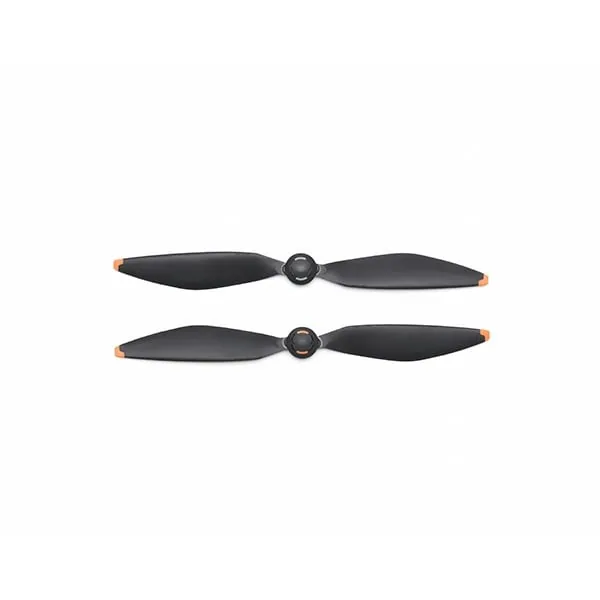
The EVO II is quieter in flight than recent DJI drones. This is probably the result of updated ESCs (electronic speed controllers) and modern propellers.